Image courtesy of Warner Bros Pictures.
Space Colonization as a Mirror to Reality: How Can Science Fiction Reveal Today’s Wounds?
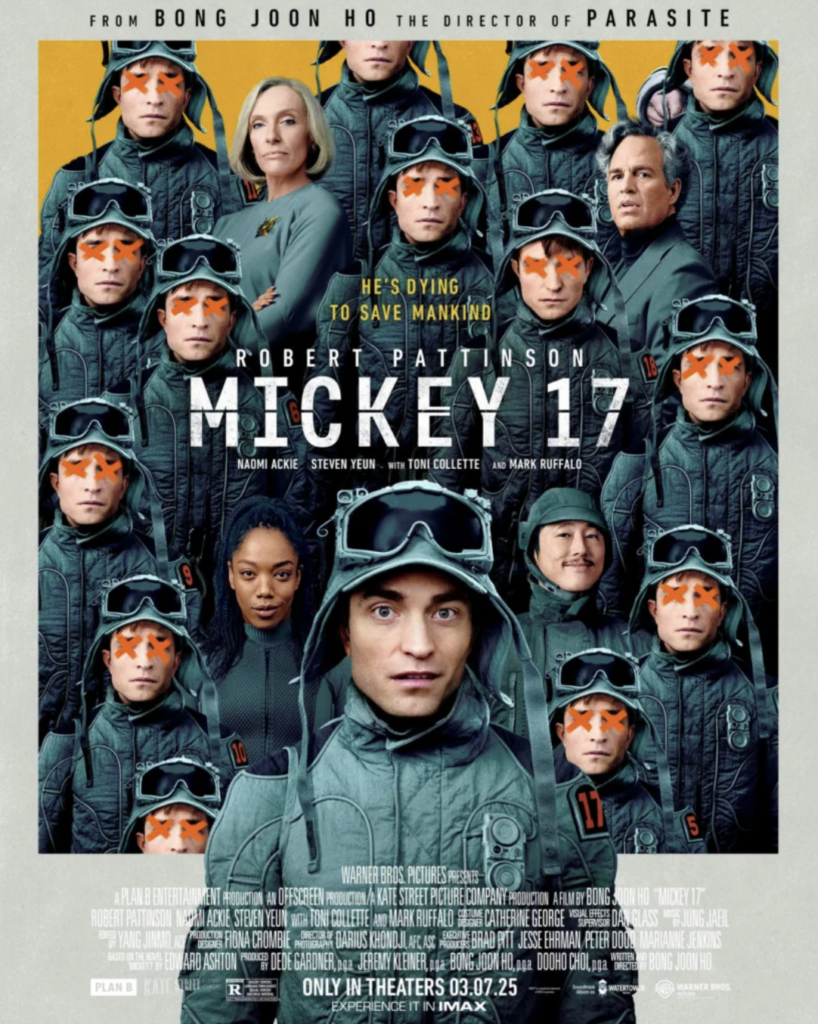
South Korean director Bong Joon-ho, the Oscar-winning genius behind Parasite, returns with his new film Mickey 17, diving into the world of science fiction loaded with bold political messages. The movie tackles themes of colonization and resource exploitation through a space adventure that soars into dark comedy, serving as a vividly colored mirror reflecting the unsettling realities of our world today.
Set in the distant future, the story follows a massive corporation that sends missions to explore new planets and extract their resources, using a “replacement worker”—a cloned being designed to perform dangerous tasks. Here enters Mickey (Robert Pattinson), who is resurrected after each death to continue working on a foreign planet. The film poses sharp existential questions: What is the value of a human when their body becomes a commodity? How is identity redefined when multiple copies of you exist?
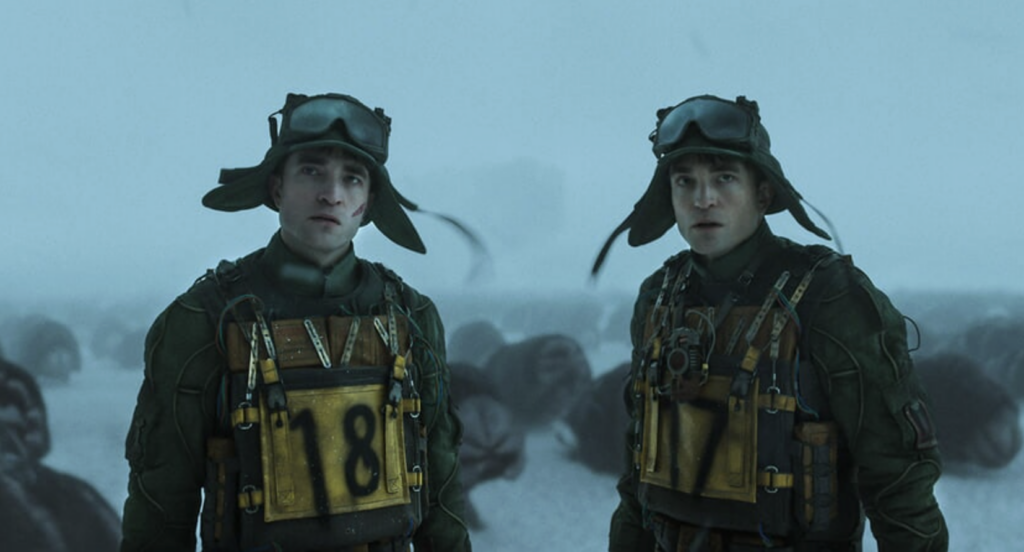
Image courtesy of Warner Bros Pictures
Bong Joon-ho does not invent a world from scratch; he weaves it from reality. In Mickey 17, colonization is not just the conquest of land but an entire economic system. The colonized planet may be rich in rare resources, exploited to serve the home planet (Earth), while the cloned worker, Mickey, of poor origin, is treated as a disposable tool. The mission is framed as “civilizing,” yet it conceals systematic destruction of the planet’s environment and native life (alien creatures), a clear allegory for European colonial crimes. Despite full awareness, Mickey is forced to sign “voluntary” contracts, echoing the exploitation of cheap labor in developing countries by multinational corporations under ruthless capitalism.
Robert Pattinson delivers a pivotal performance in his career. Mickey is not a traditional hero but a worn-out being grappling with the loss of meaning with each new iteration. Pattinson conveys this struggle with subtle expressions—the sorrow in his eyes, the quiet voice hiding latent rebellion—and brilliantly plays two different versions simultaneously: Mickey 17, submissive to the system, and Mickey 18, a radical mutation embodying revolution against the capitalist order. In the latter, Pattinson adopts a distinct tone and expression reminiscent of his portrayal of Batman, in contrast to the obedient Mickey 17, showcasing his exceptional range.
Mark Ruffalo plays Kenneth Marshall, the mission’s overseer, with coldness and concealed malice behind a formal smile. His character represents the “human” face of evil, justifying atrocities in the name of progress and prosperity—a realistic reflection of contemporary political figures.
Image courtesy of Warner Bros Pictures
Bong Joon-ho immerses the audience in a spiral of bitter satire. Scenes of replacing Mickey while his body is still warm echo the disposability of workers in consumerist systems. Witty remarks about “system efficiency” expose the hypocrisy of capitalism, which worships productivity over humanity. This dark comedy is not for everyone: the ugliness it highlights may make some viewers uncomfortable, which is precisely Bong’s intention.
Technically, the director uses every element to reinforce his message. Cold-toned control centers contrast with the barren white surface of the planet, symbolizing the elite’s detachment from labor realities. Mickey’s perspective is narrow and claustrophobic, while the authority figures’ scenes are wide and dominating. The score alternates between sharp electronic tones (action sequences) and somber classical pieces (Mickey’s reflections), underscoring the conflict between machine and human.
The film strikes a sensitive chord: planetary colonization serves as a metaphor for modern forms of exploitation—data colonization by tech companies, bodies used by pharmaceutical giants for experiments on impoverished communities, and environmental destruction. The new planet is plundered much like the Amazon rainforest today, displacing its native life.

Image courtesy of Warner Bros Pictures
Mickey 17 does not provide easy answers; it asks a troubling question: Are we—as viewers—part of the system benefiting from exploitation, or its victims? This film is not light entertainment but a powerful artistic outcry against enduring mechanisms of oppression. Some may criticize it for its harshness or complexity, yet it stands as one of the decade’s most important science fiction works. If you are ready to confront the dark mirrors Bong Joon-ho holds up, watch this film and prepare to reconsider everything you know about “progress,” “investment,” “colonization,” and “humanity.” The film strongly recalls Okja, but set in space.
Mickey 17 proves that Bong Joon-ho remains a master at crafting works that balance intelligent entertainment with sharp social critique. If you are prepared for existential questions laced with bitter laughter, see this film—but beware: you may leave the theater wondering if you, too, are just another “Mickey” in the world system. The movie will premiere in Middle Eastern cinemas shortly after Eid al-Fitr, and our rating for it is:
8/10
About the Author